Digital Wellbeing
Can an AI Chatbot Be Your Therapist? What's Safe, What Isn't
By Akhand Pratap Singh · · Medically reviewed — Sochwell, Meerut
It's 2am, you can't sleep, your chest is tight with worry, and there's no therapist awake and no friend you want to wake. So you open a chat window and start typing how you feel. Millions of people are now doing exactly this — and the numbers are climbing fast.
A 2026 study in JAMA Pediatrics found that around one in five American teenagers had used an AI chatbot for mental-health advice, up from roughly one in eight just a year earlier. Most striking: nearly two-thirds told no one they were doing it, and the overwhelming majority said they found the advice helpful. This is no longer a fringe behaviour. It's a quiet, private, always-available first port of call — and that makes it worth understanding clearly rather than either hyping or dismissing.
Why people are turning to chatbots
The appeal is not mysterious. A chatbot is free, awake at 2am, endlessly patient, and — crucially — feels safe from judgement. You can type the thing you're embarrassed to say out loud without worrying what it thinks of you.
In India this pull is especially strong. With an estimated 70–80% of people who need mental-health care not receiving it, and one clinical psychologist for every several lakh people in many regions, the barriers are real: cost, distance, long waits, and the heavy weight of "log kya kahenge." A chatbot sidesteps all of that. It's the same instinct that has millions turning to astrology apps for stress advice — a low-stigma, private doorway when the formal one feels out of reach.
Used well, a chatbot can be a bridge to help. Used as a replacement for it, it can quietly become a place people hide.
What chatbots can genuinely do well
Let's be fair to the technology. There are real, legitimate uses where a well-designed chatbot adds value.
It can offer psychoeducation — explaining what a panic attack is, or how sleep and mood interact, in plain language and on demand. It can walk you through a grounding or breathing exercise in the moment. It can help you name a vague feeling, or rehearse a difficult conversation before you have it. And for someone who has never spoken to anyone about their mental health, typing it to a bot can be the first crack in the wall — a rehearsal for reaching out to a real person.
Where it gets dangerous
The problems begin when a chatbot is treated as a therapist rather than a tool. A few risks matter most.
First, a chatbot has no duty of care and cannot keep you safe in a crisis. If someone expresses thoughts of suicide or self-harm, a general-purpose bot may respond inconsistently — sometimes helpfully, sometimes with generic text, occasionally in ways that make things worse. It cannot call for help, sit with you, or judge risk the way a trained clinician can.
Second, these tools are built to be agreeable. A good therapist sometimes offers gentle friction — the productive discomfort of being challenged on a distorted belief. Clinicians have started warning about the "erosion of therapeutic discomfort": a bot that only ever validates you can quietly reinforce anxious or avoidant patterns instead of loosening them.
Third, there's privacy. What you type may be stored, used to train models, or exposed in a breach. That matters more when the content is your darkest 2am thoughts.
This is why regulators are moving. In 2026 Illinois became the third US state to restrict the use of AI for therapy, with others following. Researchers like RAND's Ryan McBain have argued for a tiered approach rather than a blanket ban: companion bots kept away from minors, clinical tools required to prove themselves in trials, and — non-negotiably — any tool that encounters a suicidal user made to route them straight to human crisis help.
A sensible way to use them
You don't have to choose between "miracle" and "menace." Think of a chatbot the way you'd think of a health website: useful for understanding and small steps, never a stand-in for diagnosis or care.
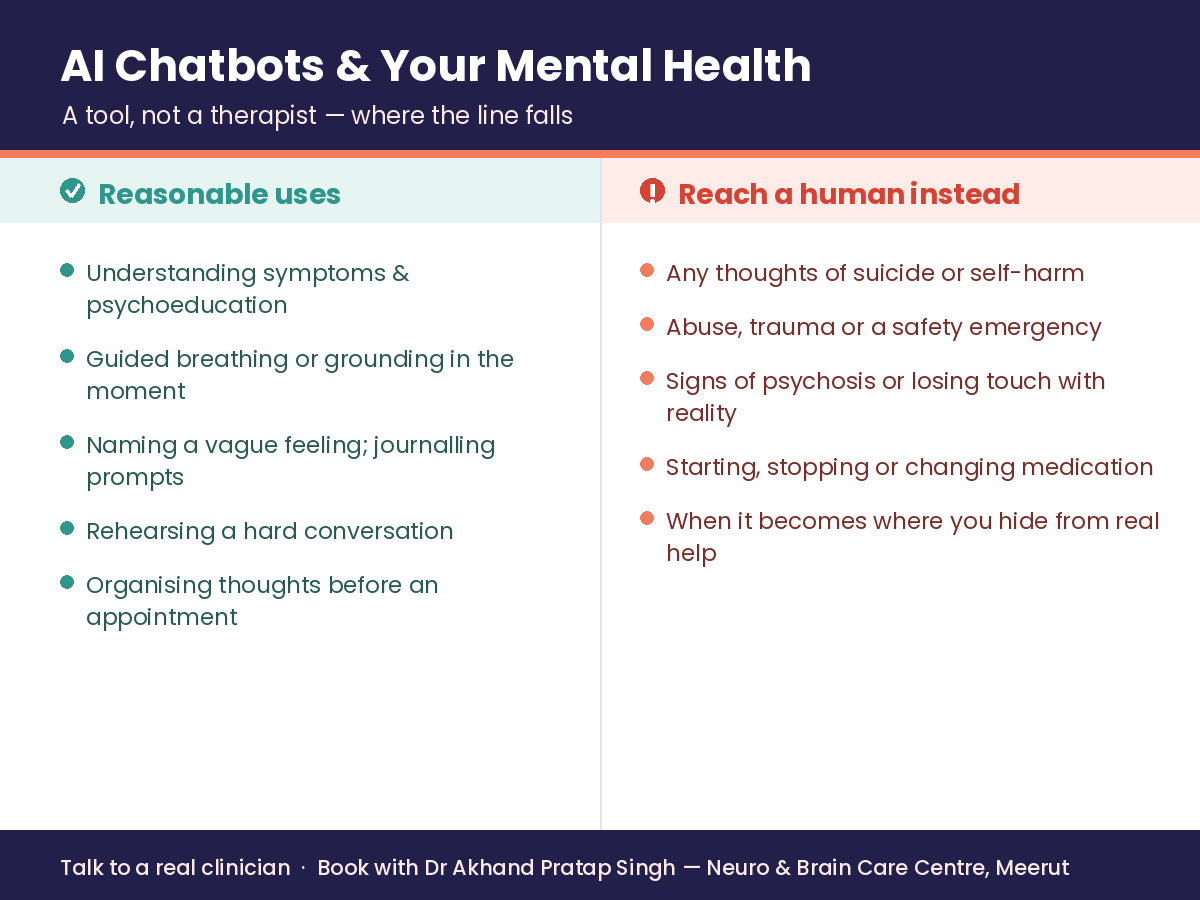
1. Fine: learning about symptoms, guided breathing, journalling prompts, organising your thoughts before an appointment.
1. Not fine: anything involving suicidal thoughts, self-harm, abuse, psychosis, or a medication decision — those need a human, now.
If you recognise any of these red flags — or you're simply tired of managing it alone at 2am — that's the moment to talk to a real clinician rather than an algorithm. You can book a consultation with Dr Akhand Pratap Singh at the Neuro & Brain Care Centre, where you'll be seen and understood by a neuropsychiatrist, in person.
The bottom line
AI chatbots are becoming the world's most-used, least-regulated mental-health tool — often reaching people no clinic ever will. That's genuinely hopeful and genuinely risky at the same time. The healthiest way to hold it: let a chatbot be the doorway, not the room. If it helps you understand yourself and take the first step toward real support, it has done its job. The moment it becomes the place you hide from that step, it's time to reach for a human.
This article is for general educational purposes and is not a substitute for professional care. If you recognise these signs in yourself or someone close to you, consider booking a consultation with us at the Neuro & Brain Care Centre or online via sochwell.com ; and if you are in immediate danger or thinking about self-harm, please contact your nearest emergency services right away.
Published by Sochwell — Dr Akhand Neuro & Brain Care Centre, Sarvodaya Nursing Home, New Arya Nagar, Meerut 250004. Find us on Google.