Forensic Psychiatry
The Unsound Mind: What the Law Means, and What It Doesn't
By Akhand Pratap Singh · · Medically reviewed — Sochwell, Meerut
On a January morning in 1843, a Scottish woodturner named Daniel M'Naghten walked up behind a man on a Whitehall street and shot him, convinced that the Tory establishment had been hounding him for years through a web of spies and priests. The man who died, Edward Drummond, was private secretary to the Prime Minister, Robert Peel; M'Naghten had mistaken the one for the other. He was tried, found "not guilty by reason of insanity," and confined for the rest of his life. The verdict so unsettled Victorian England that the House of Lords summoned the judges of the common-law courts to explain themselves, and their answer — the M'Naghten Rules — has shaped how the English-speaking world reasons about madness and guilt for nearly two centuries. It shapes, in only lightly altered language, how a court in Delhi or Lucknow will reason about it this week.
We usually approach this subject with a settled intuition: that a psychiatric diagnosis is, in some rough way, a defence — that to be mentally ill is to be, to that degree, excused. It is an intuition the newspapers encourage every time a terrible crime is followed by the phrase "history of mental illness," and it is almost entirely wrong. The category the law is actually working with is not a medical description at all. "Unsoundness of mind" is a juridical fiction — a moral instrument dressed in clinical-sounding clothes — and the distance between that fiction and the reality of a suffering patient is the most misunderstood thing in this entire field.
The law is stingier than the clinic
Consider the statute. Section 84 of the old Indian Penal Code — carried forward, almost word for word, as Section 22 of the new Bharatiya Nyaya Sanhita of 2023 — exempts a person who, "by reason of unsoundness of mind, is incapable of knowing the nature of the act, or that he is doing what is either wrong or contrary to law." Read it slowly and notice what it does not say. It says nothing about whether the accused was ill, or diagnosed, or in torment. It asks a single, narrow, cognitive question: at the instant of the act, did this person know what he was doing, and know that it was wrong?
This is the M'Naghten inheritance, and it is unforgiving. Indian law recognises no "irresistible impulse," no volitional limb, no excuse grounded in the collapse of self-control while knowledge remained intact. A man may be floridly psychotic, may hear voices, may carry a thick file of hospital admissions, and still be held fully responsible — because the law's question is not "were you unwell?" but "did you understand?" The Supreme Court has said this in almost every register available to it. In Bapu v. State of Rajasthan it held that "every person who is mentally diseased is not ipso facto exempted from criminal responsibility," and that mere abnormality, partial delusion or compulsive behaviour affords no protection. In Surendra Mishra v. State of Jharkhand it drew the line that matters most: the accused must prove legal insanity, not medical insanity. In Hari Singh Gond it conceded, revealingly, that "unsoundness of mind" is nowhere even defined in the penal code — because it was never meant to be a medical term at all.
The law is far more parsimonious than the clinic. It does not ask whether you were ill. It asks whether, in the instant of the act, you knew what you were doing and knew that it was wrong. Almost no one meets that test — and that is the point.
An old phrase that refuses to die
There is a quiet irony worth dwelling on. In 2017 India passed a Mental Healthcare Act that speaks a thoroughly modern language — "mental illness," care, capacity, dignity, the presumption of stress rather than sin. And yet, when Parliament rewrote the entire criminal code six years later, it reached back and preserved the Victorian phrase intact. Our brand-new penal law still turns on "unsoundness of mind," a category that would have been legible to the judges who questioned M'Naghten's sanity in 1843.
That persistence is not mere carelessness. It is a signal that the law is doing something other than medicine, and knows it. Medicine describes; law adjudicates. Psychiatry asks what is wrong with a person and how to relieve it; the criminal law asks whether a person is a responsible agent — a bearer of that peculiar Enlightenment dignity, the capacity to be held to account. The two enterprises overlap, borrow from each other, sit in the same courtroom, and are not the same. To collapse them is to misunderstand both.
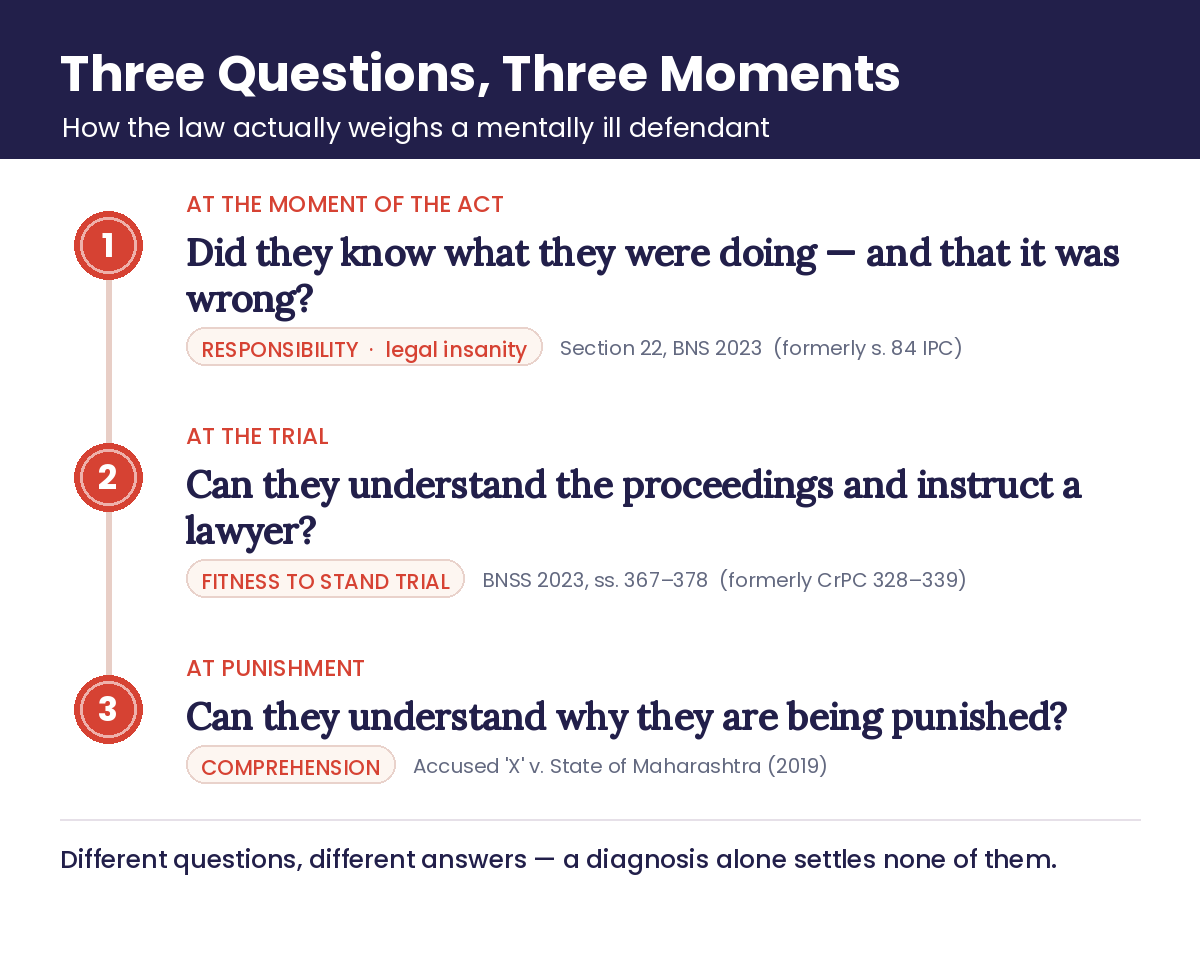
Three questions, at three different moments
Much of the public confusion dissolves once you see that the law is not asking one question about "the mentally ill" but at least three, at three distinct points in time, and that the answers do not travel together.
The first is responsibility, fixed at the moment of the act: was the person, then, capable of knowing what he did? The second is fitness, asked at the time of trial: can the person now understand the proceedings, follow the evidence, and instruct a lawyer in his own defence? A person may be perfectly responsible for the act yet, years later, too unwell to be tried — the old Code's provisions for the "accused person of unsound mind," Sections 328 to 339, now recast as Sections 367 to 378 of the Bharatiya Nagarik Suraksha Sanhita, exist precisely for that gap. The third question comes later still, at the very threshold of punishment: in Accused 'X' v. State of Maharashtra, the Supreme Court held that a post-conviction severe mental illness so grave that a prisoner can no longer comprehend why he is being executed is itself a reason to spare him the gallows.
And there is a fourth distinction the courts have had to spell out because we so reliably miss it. Earlier this year, in State v. Neeraj, the Delhi High Court patiently explained that "unsoundness of mind" and "mental retardation" — intellectual disability — are not the same thing, medically or legally, and that a person found to have one cannot simply be waved back into the world without a court weighing the act, the condition and the expert evidence. Mental illness, mental disability, unfitness to stand trial, legal insanity: four different ideas, which our discourse insists on melting into a single lump labelled "mad."
Why the fiction is humane
It is tempting to read all this as machinery for denying suffering — a legal apparatus designed to march the unwell to prison while the lawyers debate Latin. But that reading misses the deeper moral architecture. The same legal imagination that is miserly about excuse turns out to be generous about dignity, and for the same underlying reason: it takes the mentally ill seriously as persons rather than as a category of danger.
This is why the Mental Healthcare Act, in Section 115, decriminalised the attempt to end one's own life — presuming, notwithstanding the old penal provision, that a person who attempts suicide is under severe stress and owed care, not a charge sheet. If you have ever needed that reminder yourself, the government's Tele-MANAS helpline is free, at 14416. It is why the Court in Accused 'X' would not let the state execute a man who could no longer understand his own sentence. A society that insisted on treating every diagnosis as an alibi would, paradoxically, be treating the mentally ill as less than full members of the moral community — as things that happen rather than people who act. The law's stinginess about excuse and its tenderness about dignity are two expressions of a single commitment: that a person with a mental illness is, first and last, a person.
What we owe the distinction
The confusion, then, is not a harmless technicality. It corrodes in two directions at once. When we treat a diagnosis as a defence, we quietly insult the moral agency of the overwhelming majority of people who live with mental illness and who are, like the rest of us, responsible for what they do. And we feed the oldest and laziest of public syllogisms — that madness means menace — which is precisely the prejudice that keeps people from ever walking into a clinic in the first place. The forensic question the law keeps asking — is this person a responsible agent? — is one a constitutional democracy cannot outsource to a brain scan or a diagnostic label. It remains, stubbornly and rightly, a moral question that a society must keep answering for itself.
To hold that line — to insist that compassion for illness and respect for agency are not opposites but the same idea — is not a lawyer's pedantry. It is the whole of a decent psychiatry, and the reason a place like Sochwell, and a clinic like the Neuro & Brain Care Centre, exists in the first place.
This essay is general information about law and psychiatry, not legal or medical advice. If you or someone you know is struggling, in India you can reach the free Tele-MANAS helpline at 14416.
Sources & further reading
*- Section 84, Indian Penal Code 1860 → Section 22, Bharatiya Nyaya Sanhita 2023 (wording retained).
- M'Naghten's Case (1843) 10 Cl. & F. 200; 8 Eng. Rep. 718.
- Dahyabhai Chhaganbhai Thakkar v. State of Gujarat, AIR 1964 SC 1563 (burden of proof).
- Ratan Lal v. State of M.P. (1970) 3 SCC 533 (crucial time = moment of the act).
- Bapu @ Gajraj Singh v. State of Rajasthan (2007) 8 SCC 66.
- Hari Singh Gond v. State of M.P. (2008) 16 SCC 109.
- Surendra Mishra v. State of Jharkhand (2011) 11 SCC 495 (legal vs medical insanity).
- State of Rajasthan v. Shera Ram (2012) 1 SCC 602.
- Accused 'X' v. State of Maharashtra (2019) 7 SCC 1 (severe mental illness & the death penalty).
- State v. Neeraj, 2025:DHC:4233, Delhi High Court (unsoundness of mind vs intellectual disability).
- Fitness to stand trial: CrPC ss. 328–339 → BNSS ss. 367–378.
- Mental Healthcare Act 2017, ss. 105 & 115.
- Math SB, Kumar CN, Moirangthem S. "Insanity Defense: Past, Present, and Future." Indian J Psychol Med 2015;37(4):381–387.
Published by Sochwell — Dr Akhand Neuro & Brain Care Centre, Sarvodaya Nursing Home, New Arya Nagar, Meerut 250004. Find us on Google.