Youth Mental Health
Why 6 in 10 Mental Illnesses in India Begin Before 35 — and What That Means for Your Family
By Akhand Pratap Singh · · Medically reviewed — Sochwell, Meerut
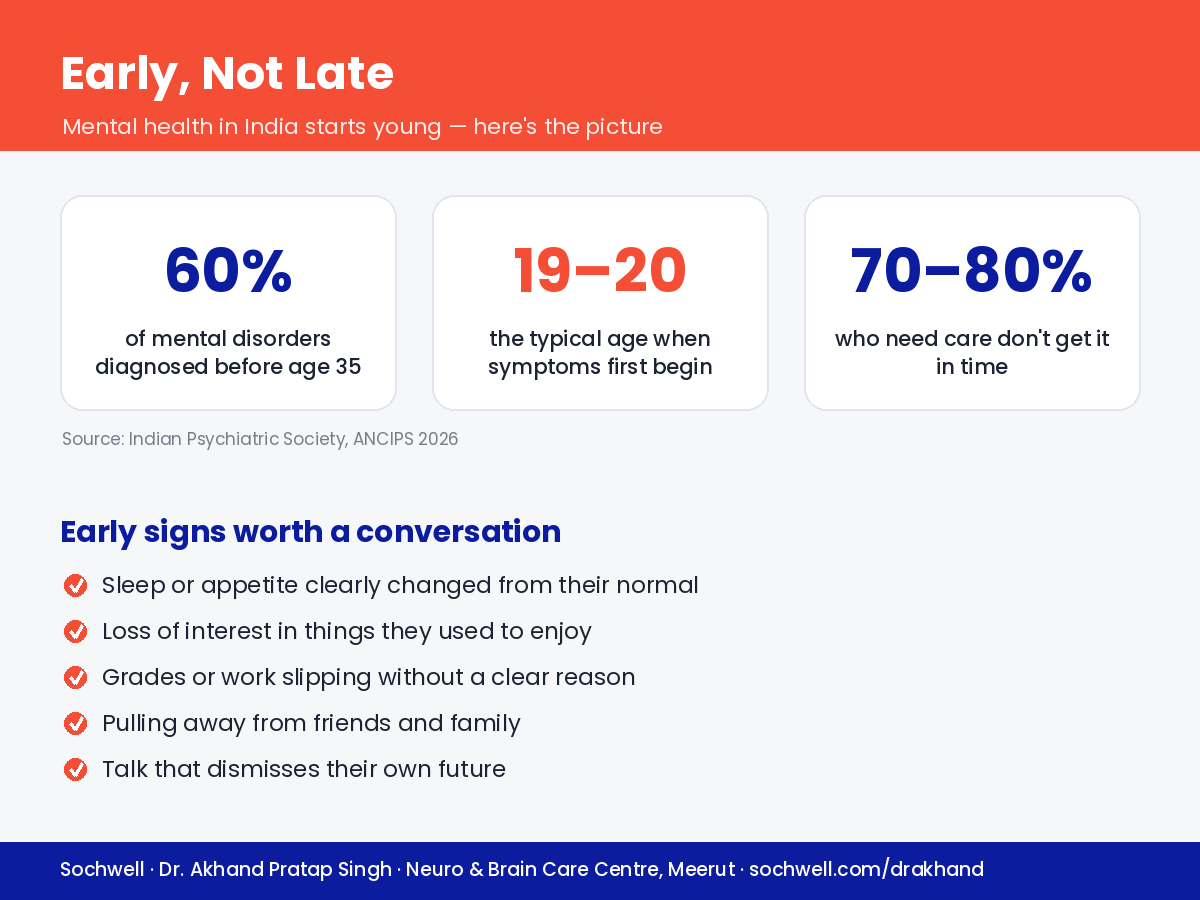
If you picture a mental illness, you might imagine it arriving later in life — after a career setback, a loss, the accumulated weight of middle age. The data tells a very different story. In India, mental health conditions are overwhelmingly illnesses of the young. At the Indian Psychiatric Society's ANCIPS 2026 conference, experts underlined a striking figure: roughly six in ten mental disorders in India are diagnosed before the age of 35, with the typical age of onset falling between 19 and 20.
That single fact reframes everything about how families, schools, and workplaces should think about mental health. These are not conditions that mostly strike "later." They tend to begin in the exam years, the first-job years, the finding-your-feet years — precisely when a young person is least likely to name what is happening, and most likely to be told to simply push through.
This is not only an Indian pattern
The Indian figures sit inside a well-established global one. The largest study of its kind, a meta-analysis of 192 studies published in Molecular Psychiatry, found that the peak age for a mental illness to first appear is just 14.5 years. By that analysis, 34.6% of all mental disorders begin before age 14, 48.4% before 18, and 62.5% by the age of 25. In other words, close to half of all mental illness has already begun before a person finishes school, and nearly two-thirds before they finish their education or settle into a first job.
Read alongside the Indian data, the message is hard to miss: adolescence and early adulthood are not a calm runway before the "real" risks of adult life. They are the highest-risk window there is.
Close to half of all mental illness begins before a person leaves school. For most people, a condition has already introduced itself long before middle age.
Why the young years are the vulnerable years
There is a biological reason these years carry so much risk. Adolescence and early adulthood are a period of enormous brain development. The circuits that govern emotion, impulse, reward, and stress are still maturing well into the mid-twenties. That plasticity is what makes young people such quick learners and such bold thinkers — and it is also what leaves the developing brain more exposed to anxiety disorders, depression, bipolar disorder, and psychosis during this exact window.
Layer India's specific pressures on top of that biology and the picture sharpens further. Relentless academic competition, the coaching-hub culture, uncertainty about jobs, comparison amplified by social media, and the quiet expectation to never appear to be struggling all land hardest on people in their teens and twenties. The strain is measurable: data presented at ANCIPS 2026 pointed to a 101.7% rise in frequent mental distress among 18-to-25-year-olds between 2011 and 2021. And it is no coincidence that, according to the World Health Organization, suicide is now the third leading cause of death among people aged 15 to 29.
Why early problems stay hidden for so long
Here is the difficult part. Even though these conditions begin early, they are often treated late — sometimes a decade late. The Indian Psychiatric Society estimates that 70 to 80% of people who need mental health care in India do not receive timely or adequate treatment. The gap between when an illness starts and when someone finally gets help is where much of the avoidable suffering lives.
Several forces widen that gap:
Symptoms are mistaken for character. Withdrawal is read as "moody," poor concentration as "lazy," irritability as "a bad attitude." A developing illness quietly earns a personality label instead of a clinical one.
"Log kya kahenge" runs deep. The fear of what people will say — about marriage prospects, about the family's reputation — keeps many young people, and their parents, from ever raising the subject at all.
The result is that a treatable condition at 18 can slowly become an entrenched one at 28 — not because help did not exist, but because no one connected the early signs to a reason to seek it. Each year of delay tends to make an illness harder to treat and more disruptive to a young person's education, relationships, and confidence.
What early signs actually look like
Early mental illness rarely looks dramatic. More often it shows up as a sustained change from a young person's own baseline — a shift that lasts more than two weeks and starts to get in the way of ordinary life. Signs worth paying attention to include:
- Sleep or appetite that has clearly changed from their normal pattern
- A loss of interest in activities, friends, or subjects they used to enjoy
- Grades or work slipping without an obvious external cause
- Pulling away from family and friends, or unusual irritability
- Physical complaints with no clear medical explanation, or talk that dismisses their own future
Any one of these can be entirely ordinary — a rough week, a hard exam, a bad night's sleep. A cluster of them, persisting and interfering with daily life, is worth a conversation with a professional. Not to slap a label on a young person, but to understand what is actually going on.
Why noticing early matters so much
Catching these changes early is not about pathologising a difficult phase of life. It is about timing. Intervening close to the onset of an illness can shorten episodes, protect a young person's education and relationships, and lower the odds that a first episode hardens into a lifelong pattern. In mental health, time is not neutral — for most conditions, the earlier the support arrives, the better the trajectory tends to be.
That is exactly why the age-of-onset data matters so much for families. If most mental illness begins young, then the single most valuable thing an adult can do is notice early and respond without judgement.
What families and young people can do
You do not need to diagnose anything to be genuinely helpful. The most powerful thing a parent, sibling, teacher, or friend can do is treat a lasting change in mood or behaviour the way they would treat a persistent physical symptom — with curiosity and care rather than judgement. Ask gently. Listen without rushing to fix. Keep the conversation open rather than one-off. And when the signs persist, help the young person see a qualified professional early, the same way you would book a doctor for a fever that would not settle.
If you are worried about a young person in your family, you can book a confidential consultation with Dr Akhand Pratap Singh at the Neuro & Brain Care Centre, Meerut, through Sochwell. We work with young people and their families to understand what is happening early — without labels or shame — and to build a plan that fits their life. Book a consultation here.
The headline number — six in ten before 35 — can read as frightening. It is better understood as an opportunity. If most mental illness begins young, then most of it is also being missed at the one stage where help does the most good. Catching it early is not about over-medicalising ordinary growing up. It is about giving a young person the same fair, timely chance at treatment we would give any other part of their health.
If you or someone you know is in immediate danger, please contact your nearest emergency services. This article is for general information and is not a substitute for personalised medical advice; please consult a qualified mental health professional for diagnosis and treatment.
References
1. Indian Psychiatric Society, ANCIPS 2026 — reported in The Indian Practitioner, "Six in ten mental disorders in India diagnosed before 35, experts warn at ANCIPS 2026." (≈60% diagnosed before 35; median onset 19–20; 70–80% treatment gap; 101.7% rise in frequent mental distress among 18–25s, 2011–2021.) [https://theindianpractitioner.com/six-in-ten-mental-disorders-in-india-diagnosed-before-35-experts-warn-at-ancips-2026/](https://)
2. Solmi M, et al. "Age at onset of mental disorders worldwide: large-scale meta-analysis of 192 epidemiological studies." Molecular Psychiatry (2022);27:281–295. (Peak age of onset 14.5 years; 34.6% before age 14, 48.4% before 18, 62.5% by 25.) [https://www.nature.com/articles/s41380-021-01161-7](https://)
3. Indian Psychiatric Society, ANCIPS 2026 — reported in The Indian Practitioner, "Six in ten mental disorders in India diagnosed before 35, experts warn at ANCIPS 2026." (≈60% diagnosed before 35; median onset 19–20; 70–80% treatment gap; 101.7% rise in frequent mental distress among 18–25s, 2011–2021.) [https://theindianpractitioner.com/six-in-ten-mental-disorders-in-india-diagnosed-before-35-experts-warn-at-ancips-2026/](https://)
4. Indian Psychiatric Society, ANCIPS 2026 — reported in The Indian Practitioner, "Six in ten mental disorders in India diagnosed before 35, experts warn at ANCIPS 2026." (≈60% diagnosed before 35; median onset 19–20; 70–80% treatment gap; 101.7% rise in frequent mental distress among 18–25s, 2011–2021.) [https://theindianpractitioner.com/six-in-ten-mental-disorders-in-india-diagnosed-before-35-experts-warn-at-ancips-2026/](https://)
5. World Health Organization — suicide as the third leading cause of death among people aged 15–29 (cited at ANCIPS 2026). [https://www.who.int/news-room/fact-sheets/detail/suicide](https://)
6. Indian Psychiatric Society, ANCIPS 2026 — reported in The Indian Practitioner, "Six in ten mental disorders in India diagnosed before 35, experts warn at ANCIPS 2026." (≈60% diagnosed before 35; median onset 19–20; 70–80% treatment gap; 101.7% rise in frequent mental distress among 18–25s, 2011–2021.) [https://theindianpractitioner.com/six-in-ten-mental-disorders-in-india-diagnosed-before-35-experts-warn-at-ancips-2026/](https://)
Published by Sochwell — Dr Akhand Neuro & Brain Care Centre, Sarvodaya Nursing Home, New Arya Nagar, Meerut 250004. Find us on Google.